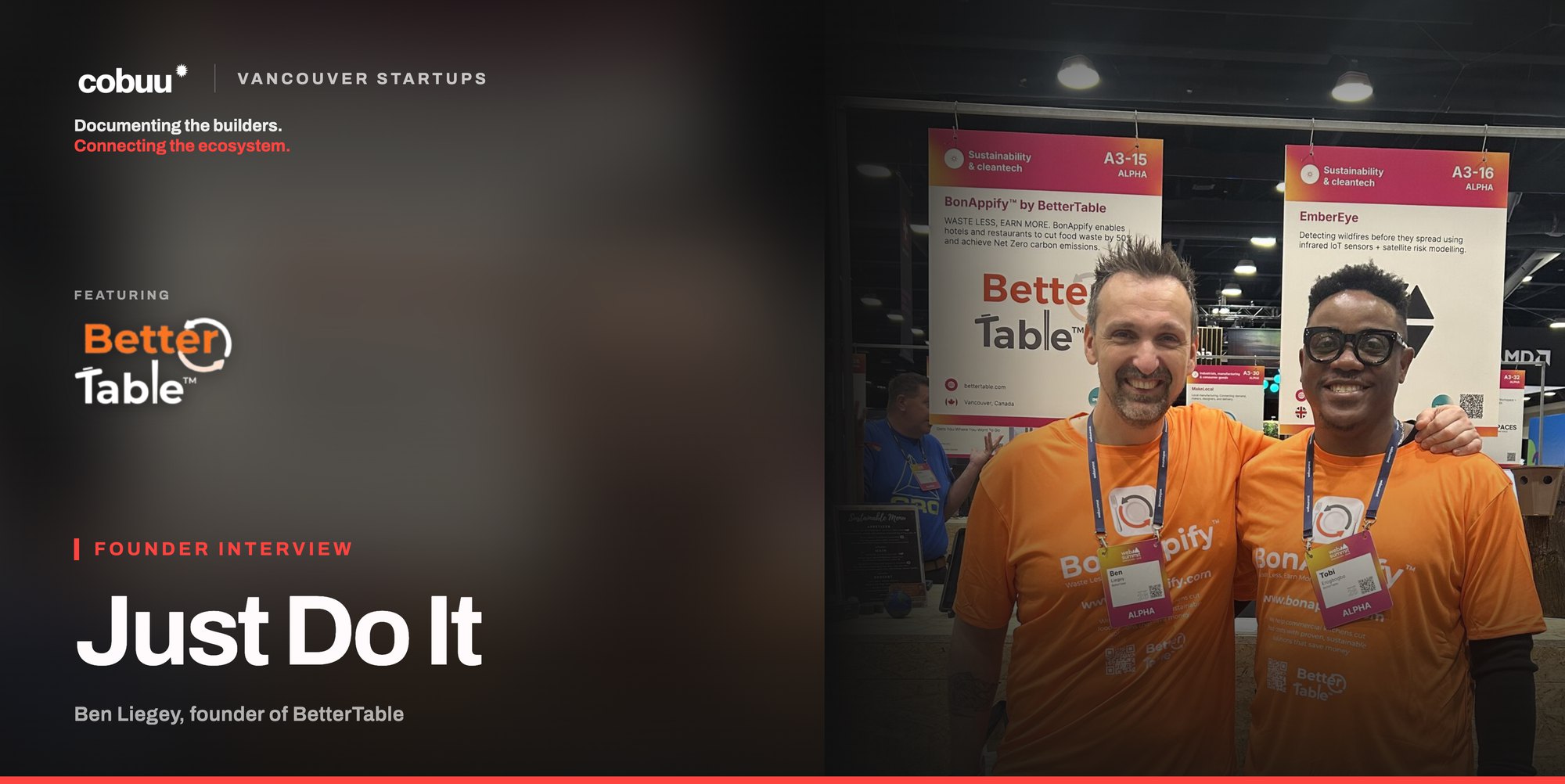
Ask Ben Liegey what he would tell someone young who wants to build something, and he does not reach for a framework or a five-step plan. He keeps it simple. Stay curious, and once you have an idea, never give up. “This may work or may not,” he says. “Just do it.”
Coming from him, it lands differently than a poster on a wall. Liegey has spent more than a decade in food sustainability, and the company he eventually built, BetterTable, came out of years of watching a problem that nobody was treating like a real business. The “just do it” is not naive optimism. It is what is left after you have done the homework and still have to choose to start.
It began with too much fruit
Liegey grew up in France surrounded by cherry and apple trees, with more fruit than one family could eat. So he sold the surplus door to door. That was his first venture, and looking back, it was already about food waste. The thread never really broke.
Part of it is generational. His father was born in 1943, in the middle of the war, and grew up knowing what scarcity meant. Liegey points to that mindset as part of why France became the first country in the world to pass an anti-food-waste law, back in 2016. You do not throw away food when you remember what it costs to not have it.
He started his career in Belgium, doing sustainability consulting across food, carbon, and water. Then he traveled, looking at food sustainability projects in different countries, before arriving in Vancouver. He says it happened a bit by chance. He did not plan to live here. He stayed for the environment, and he means that in the widest sense: mountains, ocean, good restaurants, a place where you can hike on a Saturday and care about the land because it is right in front of you.
The bet
A consulting career is a comfortable place to stay. Liegey left it because he saw a gap he could not ignore. Working in Europe and then in Canada, he kept noticing problems in one place that the other had already solved, and a lack of support around food waste specifically. The chance to bring good ideas across cultures and aim them at a problem he had worked on for over ten years was the thing that pulled him out of advising and into building.
Vancouver gave him a useful contradiction to work with. Metro Vancouver made composting compulsory back in 2015, which is genuinely ahead of the curve. But as Liegey points out, the region does not produce much of its own food to compost in the first place, and a lot of the supply chain runs through the US. The gap between the green reputation and the green reality is exactly the kind of space a founder can build in.
He started during the pandemic and incorporated BetterTable in 2023. The company is the consulting and overarching brand. BonAppify is the technology platform, the part that does food sustainability work remotely and at scale. He was careful to keep those two names straight, because people mix them up.
Why he leads with money
Here is where Liegey breaks from most people in his world. He does not lead with saving the planet. He leads with the bottom line.
I don’t care why people do it, as long as they do it.
“Everyone understands money,” he says. “Not everyone understands carbon emissions.” Most chefs, in his experience, do not spend their day thinking about their carbon footprint. So if return on investment is the door that gets them to act, he is happy to walk through it. “I don’t care why people do it, as long as they do it.” Awareness is still low, which is part of why he worked on the Food Synergy film in the first place, but the principle holds: whatever angle gets someone moving is the right angle.
What he is building toward is a measurable, two-sided system. Businesses get to quantify their impact, save money, save food, and reduce emissions, and get recognized for it. Consumers get to find the restaurants doing the work. Good business and good behavior pointing in the same direction.
On Vancouver, and on starting
He calls Vancouver a good place in Canada to build a company. There is more of a sustainability mindset here than in other provinces. But he is honest about the limits. Despite all the talk about being the greenest city on earth, there is still a lot that could be done.
The ecosystem is real but loose. He points to groups like Vancouver Food Runners, Foodstash on the retail side, and others working different parts of the food supply chain. What does not exist yet is a formal hub that ties them together. Collaboration happens, but mostly when paths cross, through things like the Metro Vancouver waste strategy work he has been part of for the last four years. No dedicated framework. Just people in the same rooms when the rooms exist.
And if he were starting over? He would narrow down sooner. Pick a sharper target market instead of trying to talk to everyone who cares about food. His advice for figuring that out is the same advice that opened this piece. Start. Do the interviews. Find the balance by doing, not by planning. Embrace the uncertainty, trust your gut, and just do it.
“I don’t care why people do it, as long as they do it.”