Interview
More Money, Straight Up
Arvin Madhi wants Vancouver’s capital to move at the speed of its ambition. In the meantime, he is quietly cancelling everything that stops earning its keep.
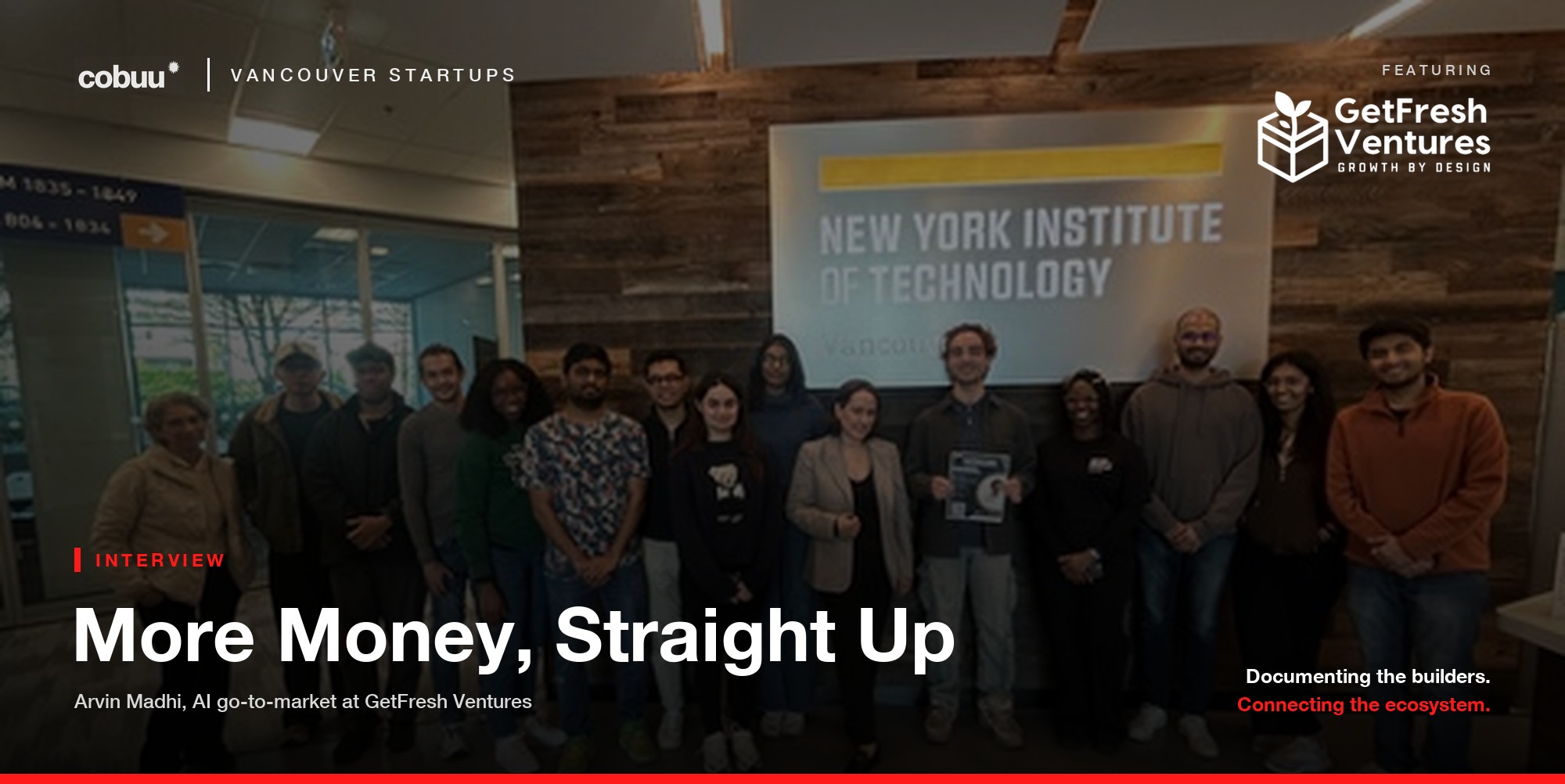
Arvin Madhi runs AI go-to-market at GetFresh Ventures, and the last year has given him reasons to feel good about the city he does it in. Web Summit moved to Vancouver from Toronto. Anthropic started running Claude Code meetups here with their own staff in the room. Apple held a developer event in the city last week about its AI frameworks, and he went to it, the kind of thing he does not see Apple do in Vancouver often.
Companies that size turning up and getting involved in the community here is, he says, the exciting part of the last year.
GetFresh has been in Vancouver close to ten years, longer than Arvin has worked there. The team grew up in the city and their networks are here. Their clients are in Canada and the US, and most of the work is remote, so they fly out only when someone needs them in the room.
I don’t think we’re ever gonna move.
More money, straight up
Ask him what he wants for Vancouver over the next year and the answer arrives without a preamble.
More money, straight up.
There is money here and there are startups here. What he wants is for the money to move faster. He sees the same thing on the client side, where an American contract gets signed quicker, and for more, than a Canadian one.
With investors the pattern repeats. The local ones run heavy due diligence for small cheques, while the American ones ask “two or three questions and then here’s a million dollars.” A founder facing a hundred questions has to go away and model the math, which Arvin does not think is worth doing for a hundred thousand dollars.
He does not think regulation causes any of this. He puts it down to appetite for risk, and says the gap has widened since AI, because the American side keeps moving faster.
There is a second gap underneath the first. Nothing here takes a company from having an idea to having investors. In the US a founder can go through a program and come out the other side funded.
There’s no place you can go and then three months later your startup’s all cleaned up and now you have investors waiting to give you money.
He would like to see investors and founders working together more closely than they do.
No evals, just the real work
Arvin has no eval suite and no test he runs. When a new model ships he does not build a benchmark for it. He points his real work at it, connectors and all, and sees if it holds up for a day or two. He says that is his own fault and he does not recommend it.
One recent week looked like this. Monday he was on Codex, then decided the model had been nerfed. He moved to Claude on Fable and burned through his weekly usage in a day. Midweek he tried Kimi. Friday, Opus 5 shipped, so he went back to Claude.
He turns on thinking so he can read the reasoning while the work happens. He had told Claude to fix an ad attribution pipeline if it found it broken, and read this back:
Well, the user said to fix it, but this is going to make a change to live production software, so I’m not sure, but it should be a pretty harmless fix, but the user said so, but I shouldn’t be taking this.
His reply: “I told you to do it. It’s fine. Just do it.”
Claude does the same thing with credentials, stopping short of creating an API token so he can press accept himself. He gives it anything sensitive for that reason. When Claude refuses a task outright, or hesitates the way it did on that pipeline, he routes the work to another model instead of arguing with it.
What gets cancelled
He cancels a tool when AI does the job better and the tool is expensive. If only one of those is true, he keeps paying.
GetFresh cancelled their CRM. It cost a lot and nobody opened the interface, because the team was updating records through AI anyway. What they built instead updates the deal itself, working from his email and the transcript of the call.
Linear went the other way. He could rebuild it in a day, but it is cheap and agents read and write to it cleanly, so he is “totally fine to pay for” it.
The two recorders
GetFresh pays for two meeting recorders. One puts a bot in the call, which is intrusive, but it also records the video. The other runs without a bot, so it is quieter on the call, but it only gets audio and it takes up memory on his laptop. Google Meet is already recording the same calls, so Arvin is trying to “bend Google’s APIs” and get the recording and the transcript pushed into their own system directly.
His version is running now, on the same meetings, next to the two tools they are still paying for. Nobody on the team has been told to stop using them, and he will not say anything until he can see where his version falls short.


“More money, straight up.”